
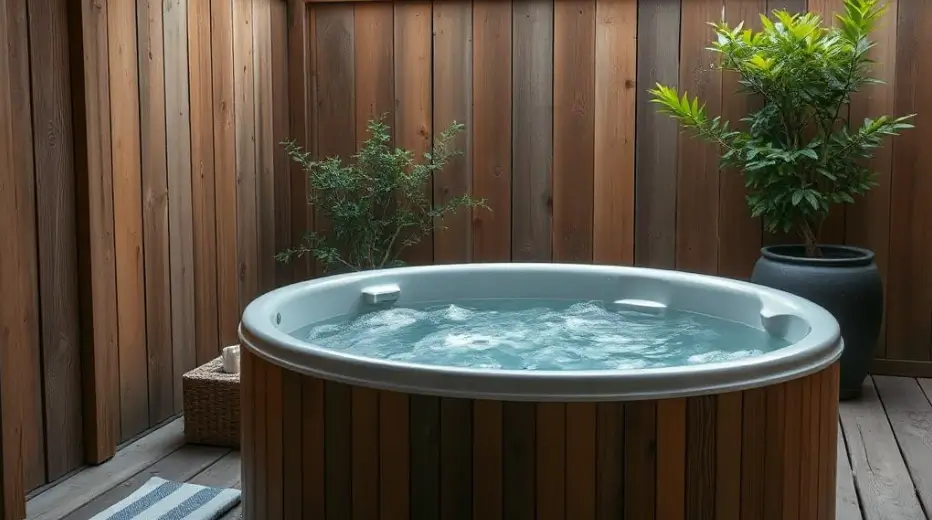
Renu Therapy Cold Plunge: A Practical Owner Review

Renu Therapy Cold Plunge: A Practical Owner Review is worth evaluating through the homeowner’s real week, not a perfect catalog photo. The best setup is the one that gets used, stays safe, and does not become a maintenance headache.
A friend of mine, Jake, coaches high school wrestling in upstate New York. Last November he finally pulled the trigger on a cold plunge for his garage. He’d been pricing units for two years. The tub itself cost $5,200. Fine. But then came the concrete pad ($1,400), a dedicated 20A circuit run by an electrician ($650), and a weekend of his time leveling the site and running a garden hose through the basement window in 34-degree weather. “The unit was the easy part,” he told me over the phone. “Nobody talks about the other thousand bucks and the Saturday you lose.”
Jake’s experience is basically the whole story of home cold plunge ownership compressed into one sentence. The unit is half the project. The site is the other half. Get both right and you have something you’ll use every morning for years. Get the site wrong and you have an expensive, heavy problem sitting on a cracked pad.
What Actually Matters on a Spec Sheet
Most cold plunge buyers spend too long comparing brand names and not long enough reading specs. Here’s the short list that actually determines whether you’ll be happy with a unit six months in.
Chiller capacity. Match it to tub volume and your climate. A 1/3 HP chiller holds 50°F in a 75-gallon insulated tub when it’s 70 outside. Put that same chiller in a Phoenix garage in August and it runs nonstop, burns out the compressor, and you’re shopping again. A 1 HP commercial-grade chiller is overkill for a small residential tub in Portland but exactly right for a larger stainless build or a warm climate. Read the manufacturer’s sizing chart. Don’t trust a Reddit thread from someone in a different zip code.
Filtration and sanitation. The combination of ozone, UV, and a 5-micron cartridge filter is now standard on purpose-built units. This is what lets you go 6 to 12 weeks between full drain-and-refills. Stock-tank DIY setups skip all of this, which means you’re either draining constantly or swimming in something you’d rather not think about.
Tub material. Stainless steel is the commercial standard. Rotomolded polyethylene is lighter, cheaper, and fine for residential use. Acrylic shows up in some mid-tier units. The material choice matters less than insulation quality, which determines how hard the chiller works (and how much electricity you burn).
Electrical. Most residential cold plunges are plug-and-play 110V. Some commercial-grade units require 240V hardwire, which always means a licensed electrician. No exceptions. This isn’t a suggestion.
The Research, Honestly
Cold water immersion research has gotten genuinely interesting in the last decade, but it also gets oversold. Here’s where things actually stand.
Heinonen and Laukkanen reviewed cold-water immersion outcomes in 2018 (Frontiers in Physiology) and reported reductions in self-reported muscle soreness, modest improvements in mood, and measurable changes in catecholamine signaling after 2 to 5 minute immersions at 50°F to 59°F. “Modest improvements in mood” is doing a lot of heavy lifting in that sentence, but anyone who’s done a cold plunge knows the post-immersion feeling is real, even if quantifying it in a lab is tricky.
A 2022 systematic review by Allan and colleagues (European Journal of Applied Physiology) looked at cold-water immersion after resistance training and found recovery benefits, but with an important wrinkle: very frequent immersions right after lifting may blunt some hypertrophy signaling. The practical takeaway for lifters is simple. Keep cold sessions to 2 to 5 minutes and separate them from heavy resistance work by at least 4 hours when muscle growth is the priority. If you’re doing GPP or conditioning work, the timing matters less.
Here’s my opinionated take: for most recreational athletes, the biggest benefit of a home cold plunge isn’t any single physiological mechanism. It’s the consistency of a daily practice that’s mildly uncomfortable and completely voluntary. It trains the same mental muscle as getting up early to run. The catecholamine response is a nice bonus. The discipline is the real product.
That said, cold exposure spikes heart rate and blood pressure within seconds. This is not a soft intervention. Adults with arrhythmias, uncontrolled hypertension, Raynaud’s phenomenon, or who are pregnant need to clear cold immersion with a physician before trying it at home.
The Pad and the Wiring (the Boring Part That Matters Most)
A full cold plunge tub with water and a steel chassis puts 800 to 1,200 pounds on a small footprint. That’s roughly the weight of a grand piano concentrated in about 15 square feet. You need something solid underneath it.
For most backyard installs, a 4-inch compacted gravel pad with proper drainage works. In freeze-thaw climates or on soft soil, a 4-inch reinforced concrete pad is the right call. Jake’s contractor in upstate New York didn’t even discuss gravel; he went straight to concrete because the ground freezes hard by December and anything less would shift.
Budget $400 to $900 for gravel. $1,200 to $2,400 for concrete. These are boring numbers. They are also the difference between a stable installation and one that develops a lean by spring.
On the electrical side: plug the unit into a properly grounded GFCI outlet on its own dedicated circuit. If your nearest outlet is more than 25 feet away or shares a circuit with a shop vac, a fridge, anything with a motor, have an electrician run a dedicated 20A line. Budget $600 to $1,800 for a 240V run if your unit requires it.
What It Actually Costs, All In
Sticker price is a lie. Not intentionally, but by omission. Here’s what a cold plunge project really costs once you total everything.
Residential insulated tub with integrated chiller: $4,500 to $7,500. This is the most common category for home users. Includes chiller, ozone/UV, filtration, and an insulated shell.
Commercial-grade stainless build with full filtration: $9,000 to $14,000. Higher throughput, built for gyms or multi-user households.
Stock-tank DIY: $400 to $900. No chiller, no filtration. You’re buying bags of ice from the gas station and dumping them in a Rubbermaid horse trough. It works. It’s also a commitment to manual labor that most people abandon within a month (something like a gym membership in January, full of good intentions).
Add-ons to budget for: Pad work ($400 to $2,400), electrical ($600 to $1,800 for 240V), permits if required locally, and ongoing filter cartridge replacement every 6 to 12 weeks.
On the tax side, some home wellness equipment can be reimbursed through HSA or FSA accounts with a Letter of Medical Necessity (LMN) on file. Services like TrueMed issue LMNs after a clinician review for conditions where cold therapy is a recognized treatment input. Eligibility is patient-specific and IRS rules are strict. Talk to your tax advisor before assuming anything qualifies.
How It Stacks Up Against Alternatives
Compared with competitors like Plunge, Cold Stoic, and stainless DIY builds, the tradeoffs come down to footprint, chiller capacity, filtration quality, and whether you want a plug-and-play experience or a project.
A purpose-built insulated tub with a 1 HP chiller holds 39°F to 45°F all day with zero manual ice. A stock-tank conversion can hit the same temps with ice, but you’re hauling 40-pound bags three times a week. A chest-freezer conversion is the cheapest path to cold water, but it lacks filtration, the thermostat wasn’t designed for this purpose, and mechanically it’s marginal at best.
For a deeper comparison of Renu Therapy’s specific model lineup, sizing options, and price tiers, see this commercial guide. It covers chiller specs and install considerations in enough detail to be worth bookmarking before you commit to a purchase.
When to Call Someone Who Knows More Than You
Three moments in this project where paying a professional saves you real money and headaches.
The pad. Especially in freeze-thaw climates or on soft, settled soil. A pad that cracks or shifts under a loaded tub is exponentially more expensive to fix after the fact.
The wiring. Any 240V work. Full stop. And honestly, even a 110V dedicated circuit run is worth having done right if you’re not confident in your panel’s capacity.
The health conversation. If you have any cardiac history, blood pressure issues, Raynaud’s, are pregnant, or manage a chronic condition, a 10-minute conversation with your physician before your first plunge is cheap insurance. The research is encouraging for healthy adults. That qualifier, “healthy adults,” is doing important work.
FAQs
How long does a cold plunge chiller take to reach target temperature?
A cold plunge chiller pulls a freshly filled tub from tap temperature down to 45°F in 3 to 8 hours, depending on chiller size, insulation, ambient temperature, and starting water temp.
How long should a cold plunge session last?
Most adults land between 2 and 5 minutes at 40°F to 55°F. Build up gradually if you’re new. There’s no prize for staying in longer, and the diminishing returns kick in quickly after about 4 minutes for most people.
Can I put a cold plunge on a deck?
Some smaller units can sit on reinforced decks if the framing supports the loaded weight (often 600 to 1,200 pounds). Most larger units belong on a ground-level pad. Confirm load capacity with a structural engineer or your contractor before placing any unit on existing decking.
How often does a cold plunge need maintenance?
Replace filter cartridges every 6 to 12 weeks. Run ozone or UV on the manufacturer’s schedule. Test pH and sanitizer weekly. Drain and refill per the manufacturer’s recommended interval, typically every 2 to 3 months with proper filtration.
Will a cold plunge spike my electric bill?
A 1/2 HP chiller in steady state pulls roughly 350 to 450 watts and adds $8 to $15 monthly in most climates. Larger commercial chillers draw more. Your mileage will vary with ambient temperature and how well the tub is insulated.
Is a stock-tank DIY setup worth it?
It’s worth it if you genuinely want to test the habit before spending $5,000+. It is not worth it as a permanent solution for most people, because the ice logistics and lack of filtration grind you down over time.
Can I use my HSA or FSA to pay for a cold plunge?
Possibly, with a Letter of Medical Necessity from a clinician. Services like TrueMed facilitate this process. But eligibility is patient-specific, the IRS rules are strict, and you should consult your tax advisor before assuming any purchase qualifies.
Disclaimer. This article is general consumer information, not medical advice. Cold water immersion carries real cardiovascular load. Anyone with arrhythmias, uncontrolled hypertension, Raynaud’s phenomenon, recent cardiac events, or who is pregnant should consult a physician before starting any cold plunge routine.
HSA and FSA reimbursement on wellness equipment is patient-specific and depends on a Letter of Medical Necessity from a clinician. Talk to your tax advisor before assuming a purchase qualifies.